

The Chemical Industry Welcomes a New Regulatory “Big Exam”: 5 Types of Hazardous Chemicals Must Complete Compliance Registration Before July 31
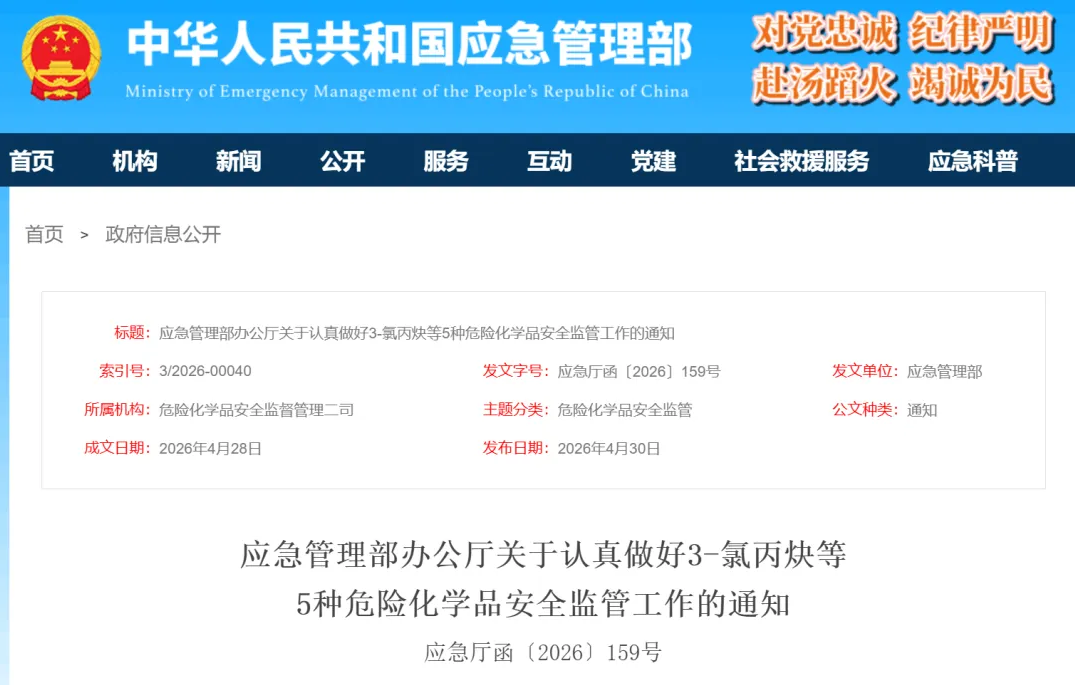
After the May Day holiday, chemical enterprises received the latest regulatory instruction from the National Ministry of Emergency Management. With the Ministry of Emergency Management and 9 other departments jointly issuing an announcement to formally include 5 chemicals—such as 3-Chloropropyne and 2-Iodoxybenzoic acid—into the “Catalog of Hazardous Chemicals (2015 Edition)”, Shijiazhuang Pengnuo Technology Co., Ltd. is facing an urgent compliance battle that admits no delay: it must complete the handling of relevant licenses and registration before July 31, 2026.
The Urgent “Countdown”: July 31 is the Red Line
For chemical enterprises, this document is not merely a notification on paper, but a tangible operating red line. According to the document’s requirements, relevant enterprises must, within three months (i.e., before July 31, 2026), handle the “Hazardous Chemical Production Safety License”, “Hazardous Chemical Operation License”, or “Hazardous Chemical Safe Use License” according to laws and regulations.
This means chemical enterprises must take action immediately:
Comprehensive Screening: Rapidly compare against the “Classification Information Table for 3-Chloropropyne and Other 5 Hazardous Chemicals” to verify the company’s current raw material list and inventory, confirming whether these 5 newly added hazardous chemicals are involved.
Supplementary Procedures: Once involved, the declaration process to the provincial emergency management department must be initiated immediately. All administrative licensing changes or new applications must be completed before the new regulations take effect; otherwise, the enterprise will face the risk of suspension of production and business operations.
Whole-Chain Registration: Not Just Production, Circulation Must Also “Leave Traces”
This supervision focuses not only on the “production end” but also emphasizes the transparency of the “circulation end.” The document clearly points out that emergency management departments at all provincial levels must urge relevant production and import enterprises to implement the “Administrative Measures for the Registration of Hazardous Chemicals”.
For enterprises whose business involves import/export or cross-provincial sales, this means a rise in compliance costs. Enterprises need to ensure that every batch of cargo involving these 5 chemicals is traceable. From raw material procurement to product leaving the factory, a complete traceability chain must be established to cooperate with the fact-finding inspections by municipal and provincial emergency management departments.
From “Knowing” to “Acting”: The Compulsory Course for Enterprises
The notification particularly emphasizes “guiding the public, especially relevant enterprises, to be familiar with the hazardous characteristics, safety requirements, and emergency response measures of the 5 hazardous chemicals.” This is not only legal education for enterprises but also a hard requirement for safety capabilities.
Enterprises need to organize all-staff training to ensure operators understand the specific risks of these chemicals (such as the flammability of 3-Chloropropyne and the oxidizing property of 2-Iodoxybenzoic acid) and revise corresponding emergency plans.
Conclusion
This notification released on May 8, 2026, marks that the state’s supervision of hazardous chemicals has entered the “deep water zone.” For Shijiazhuang Pengnuo Technology, this is both a severe compliance challenge and an opportunity to improve the enterprise’s safety management level. Whether it can successfully pass the test before the final deadline of July 31 will directly test the execution power and standardization level of this enterprise.
www.pengnuochemical.com Shijiazhuang Pengnuo Technology Co., Ltd.
Post time: May-11-2026